Here’s how an e-book Series sells. What is it that allows an e-book series to break out from the publishing Grave of Zero’s? Here is the link to the previous post in this series Publish and Pay (and trade in of your Series)
How an e-Book Series Sells compared to a singleton e-Book
Lets start at the beginning with the release of e-book One of a series. Let’s see how an e-book series sells.
As a comparison let us say an equivalent e-book is released at the same time that is not part of a series.
The red line on the idealized graph (see below) is the stand-alone e-book. While the blue line represents the first e-book in a series. Both get the same level of advertising. Neither is a simple “Organic” (or Publish and Pray) launch.
Let’s say e-book One of the series emulates the sales of a the stand-alone book exactly. Their trajectory through the Amazon A10 algorithm for the first 90 days is much the same. In fact in this hypothetical example they both follow exactly the same path.
What happens to both of them when we get to Day 60?
Both e-books enter the Grave Yard. If nothing spectacular happens, they will both stay there.
But one of these books has a saviour! It is the release of the second e-book in the series at Day 90.
Here’s how it works.
How a series e-book sells and a standalone e-book doesn’t
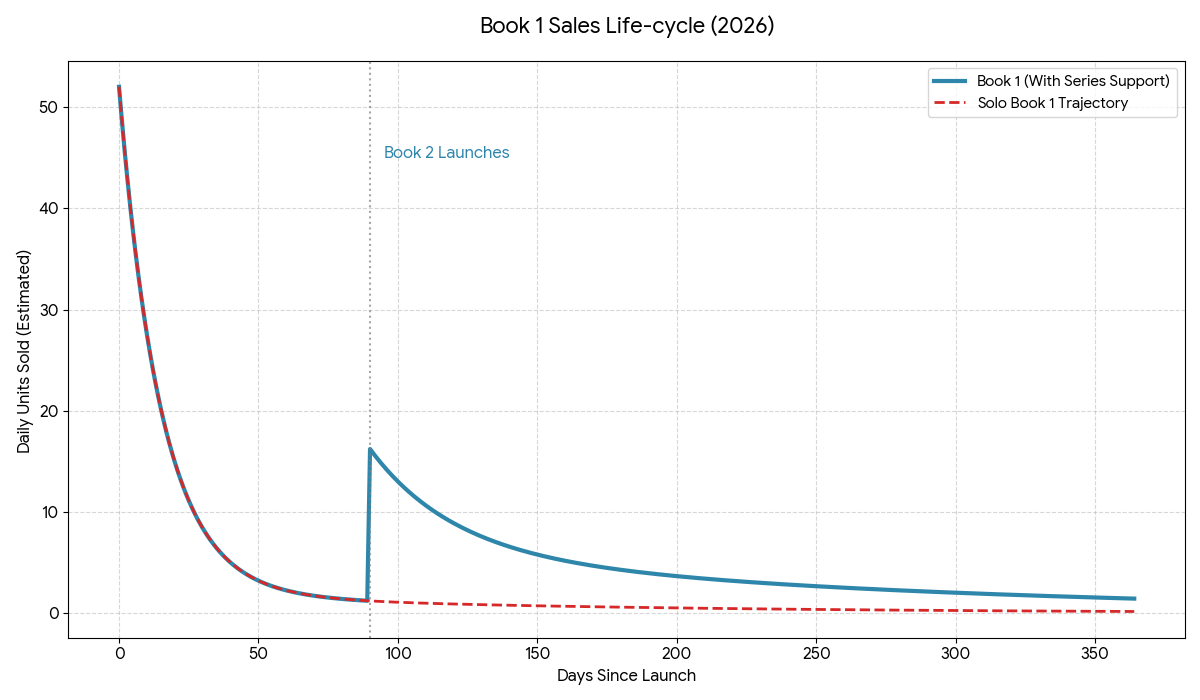
At Day 60 both e-books (whether the stand-alone or first book in a series) is in essence dead. Or at least coughing up a great deal of blood.
The stand-alone continues along the bottom to obscurity. It gets increasingly ignored by the Amazon A10 algorithm because as time goes on, it has fewer sales and fewer people are looking at it. Because it makes fewer sales A10 ignores it even more. It gets less exposure so reinforcing it’s demise. Eventually nobody sees it and so makes no (or very few) sales.
Both red and blue follow the same path to Day 90.
The 90 Day Divergence
But then at Day 90 the second part of the series is released. It has all the advantages that the A10 algorithm lavishes on a new release.
Sure, and as a result some people buy e-book Two without considering e-book One.
But it’s ALWAYS the case that many more people will view the sample and/or the authors bio than buy the e-book. Many of these people will normally just back away. Especially if the e-book is (say) £4.99. They are interested but not fully convinced. With a stand-alone book that would be it. A sale lost. Maybe they’ll come back later. Probably not.
But with the series e-book Two, in the authors Bio or within the sample or as listed in “Often Bought Together” they see there is an “earlier” book in this series and this earlier book is cheap! (aka £0.79p)
It is a reduced risk and reduced cost entry into a series which involves the e-book they were first interested in!
When Buying Becomes a Safe Option
Buying the first part of the series is a “safe” option. So they go to the e-book One sales page. They read the sample and buy it. Usually they do this with far, far less due diligence than they would have used for the fully priced second part!
They are now into the series. Assuming they like the first e-book they come back to the second. The price is now no longer a boundary. They are dealing with a known entity. Then they go on to the third and so on.
Believe it or not the resuscitation of e-book One by the launch of e-book Two sometimes exceeds the initial sales of e-book Two! The deeper the series (aka Three, Four, Five) the more the effective the feedback is. Each e-book reflects back to the origin. That origin is the CHEAP low risk serial entry point e-book One. Which is of course, written and designed to hook the reader into the series.
Of course if they hate e-book One then all bets are off. But that is always the fundamental risk with writing anything. If you write something nobody likes then its just too bad.
But if nobody even sees what you have written then nobody can find out if it’s any good in the first place!
Running e-book one at a loss yet the e-book series sells!
The other intrinsic advantage of having a series is that you can afford to run advertising for e-book One at a loss. Some (maybe lots) of your readers will go on to buy e-book Two and maybe Three Four and Five. The total eventual sales across the series caused by that initial loss-making sale of e-book One, buries the advertising cost.
None of this happens with a stand-alone. If you advertise a stand-alone at a loss then quite simply, you lose money.
It is a numbers game. Because of the bleed through to other titles in the series, advertising for e-book One is also (at the end of the day) advertising later e-books in the series (for free). And all of the e-books tweak the A10 algorithm to the advantage of all the other e-books in the series too.
Get this right and you make more than you spend. The next post in this series How an e-Book Series Works – Financially