Self Publishing: Why (and how) an e-book Series Sells.

Here’s how an e-book Series sells. What is it that allows an e-book series to break out from the publishing Grave of Zero’s? Here is the link to the previous post in this series Publish and Pay (and trade in of your Series)

How an e-Book Series Sells compared to a singleton e-Book

Lets start at the beginning with the release of e-book One of a series. Let’s see how an e-book series sells.

As a comparison let us say an equivalent e-book is released at the same time that is not part of a series.

The red line on the idealized graph (see below) is the stand-alone e-book. While the blue line represents the first e-book in a series. Both get the same level of advertising. Neither is a simple “Organic” (or Publish and Pray) launch.

Let’s say e-book One of the series emulates the sales of a the stand-alone book exactly. Their trajectory through the Amazon A10 algorithm for the first 90 days is much the same. In fact in this hypothetical example they both follow exactly the same path.

What happens to both of them when we get to Day 60?

Both e-books enter the Grave Yard. If nothing spectacular happens, they will both stay there.

But one of these books has a saviour! It is the release of the second e-book in the series at Day 90.

Here’s how it works.

How a series e-book sells and a standalone e-book doesn’t
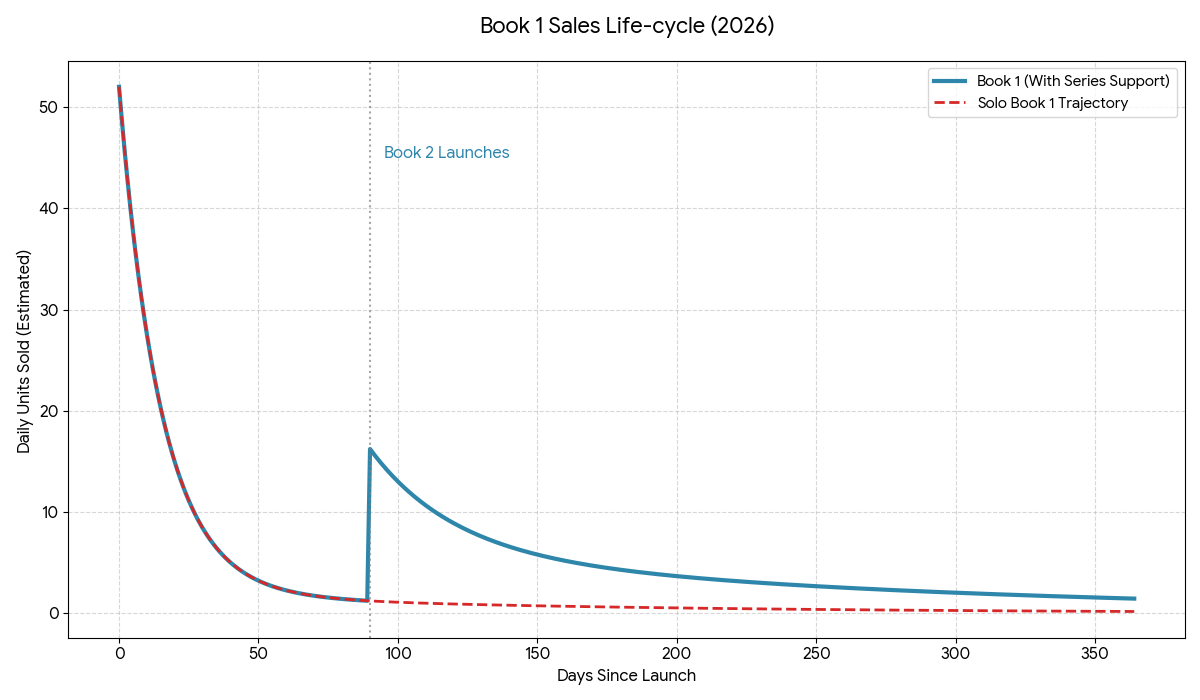
How an e-book series sells: Life-cycle of e-book one.

At Day 60 both e-books (whether the stand-alone or first book in a series) is in essence dead. Or at least coughing up a great deal of blood.

The stand-alone continues along the bottom to obscurity. It gets increasingly ignored by the Amazon A10 algorithm because as time goes on, it has fewer sales and fewer people are looking at it. Because it makes fewer sales A10 ignores it even more. It gets less exposure so reinforcing it’s demise. Eventually nobody sees it and so makes no (or very few) sales.

Both red and blue follow the same path to Day 90.

The 90 Day Divergence

But then at Day 90 the second part of the series is released. It has all the advantages that the A10 algorithm lavishes on a new release.

Sure, and as a result some people buy e-book Two without considering e-book One.

But it’s ALWAYS the case that many more people will view the sample and/or the authors bio than buy the e-book. Many of these people will normally just back away. Especially if the e-book is (say) £4.99. They are interested but not fully convinced. With a stand-alone book that would be it. A sale lost. Maybe they’ll come back later. Probably not.

But with the series e-book Two, in the authors Bio or within the sample or as listed in “Often Bought Together” they see there is an “earlier” book in this series and this earlier book is cheap! (aka £0.79p)

It is a reduced risk and reduced cost entry into a series which involves the e-book they were first interested in!

When Buying Becomes a Safe Option

Buying the first part of the series is a “safe” option. So they go to the e-book One sales page. They read the sample and buy it. Usually they do this with far, far less due diligence than they would have used for the fully priced second part!

They are now into the series. Assuming they like the first e-book they come back to the second. The price is now no longer a boundary. They are dealing with a known entity. Then they go on to the third and so on.

Believe it or not the resuscitation of e-book One by the launch of e-book Two sometimes exceeds the initial sales of e-book Two! The deeper the series (aka Three, Four, Five) the more the effective the feedback is. Each e-book reflects back to the origin. That origin is the CHEAP low risk serial entry point e-book One. Which is of course, written and designed to hook the reader into the series.

Of course if they hate e-book One then all bets are off. But that is always the fundamental risk with writing anything. If you write something nobody likes then its just too bad.

But if nobody even sees what you have written then nobody can find out if it’s any good in the first place!

Running e-book one at a loss yet the e-book series sells!

The other intrinsic advantage of having a series is that you can afford to run advertising for e-book One at a loss. Some (maybe lots) of your readers will go on to buy e-book Two and maybe Three Four and Five. The total eventual sales across the series caused by that initial loss-making sale of e-book One, buries the advertising cost.

None of this happens with a stand-alone. If you advertise a stand-alone at a loss then quite simply, you lose money.

It is a numbers game. Because of the bleed through to other titles in the series, advertising for e-book One is also (at the end of the day) advertising later e-books in the series (for free). And all of the e-books tweak the A10 algorithm to the advantage of all the other e-books in the series too.

Get this right and you make more than you spend. The next post in this series How an e-Book Series Works – Financially
Self Publishing: Publish and Pay (and Trade in on Your Series)

For a fiction e-book to be financially successful (beyond the initial A10 algorithm boost) it needs two things. An advertising budget and other e-books passively promoting it. It’s called Publish and Pay.

This is a short little post dealing with the basis of using sustained paid promotion and passive cross-referencing from other e-books in a series or group.

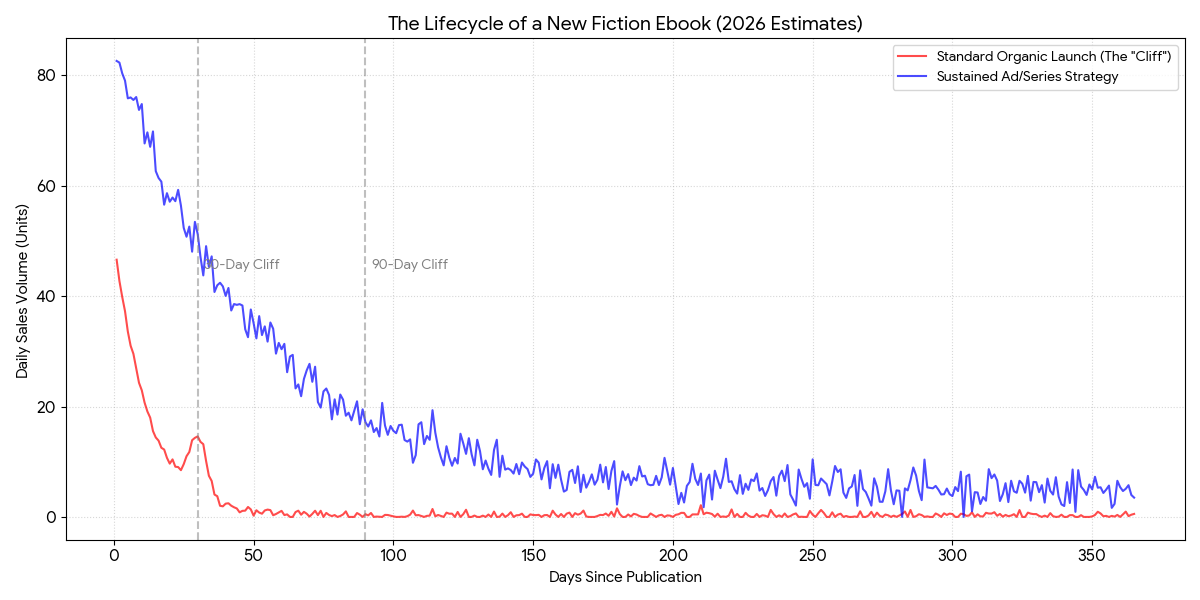
Here’s that graph again that we met in the last post: “Life and Death of an e-book”. In that post we looked at the red line – a Standard “Organic” Launch. More luridly known as “Publish and Pray”

This time we will start looking at the Blue line. That’s an e-book with a sustained ad/series strategy. Colloquially known as “Publish and Pay”.

Life and death of an e-Book. Publish and Pay versus publish and Pray

We will be looking at the blue line in quite a lot of detail in later posts. But here it is important to set the scene to see why this promoted and cross-referenced e-book continues selling well beyond the 90 windows (although at significantly reduced sales).

Believe it or not, the blue line shows a potential strategic way ahead for selling e-books. Though it is not for the faint hearted.

The blue line e-book launch is initially supported by significant advertising spend. This spend is designed to ensure the e-book is seen by as many as possible in the target market. That’s why it’s called Publish and Pay.

But that is not all. This e-book is part of a series. A series designed so that as one e-book falls out of the 90 day period, it’s successor is launched. The result is that one e-book “bleeds” into another and then another. They all cross link and cross promote (free of charge) each other.

Great! You may say. What could possibly go wrong!

Well…

The Publish and Pay Treadmill

The author is on a treadmill. Every 90 days another book MUST be launched. Then all of the advertising for the new title must start again while advertising (although reduced) for the others in the series continues.

It is a numbers game involving considerable out-going spend with no guarantee of an superior incoming return. No author involved in the strategy (whether or not it is showing signs of working) can afford to let up for one minute let alone for (say) a couple of months.

This is now a business. The lonely scribe pouring out their soul into their work is history.

You are writing as an act of self promotion as well as expanding the story(s) across multiple e-books. You are working to deadlines and word-counts.

Couple that with the fact that 90% of the effort will be promotion not writing and you can see why many who attempt this bail out half way through and probably end up losing money as a result.

BUT…

It does have the potential to work. That’s if (and only if) the Gods are on your side.

But Hey!

This is publishing!

What did you expect? Certainty?

The one big thing you can expect though from “Publish and Pay AND Trade in on your Series” is that unlike the “Publish & Pray” (red line) strategy, this is more than just buying a lottery ticket. It does have the potential to actually sell e-books. (sometimes)

It has a another name too! The “Series Halo Effect”.

We are going to look at the “Series Halo Effect” in some detail in the next post. Why and How an e-Book Series Sells

Self Publishing: Life and Death of a Fiction e-Book

How long does an e-book typically sell for? Here we look at the very brief life and death of a fiction e-book. A two part post looking at non promoted and promoted e-book launches and the duration of sales. The previous post in this series – A Look at the Odds of Financial Success

So far in this series I been looking at the issues surrounding e-book sales macroscopically or globally. i.e. the issues that affect the whole 4.8 million active fiction e-books on Amazon for example.

What I’m going to do now is look at how this all relates to individual e-books and especially how they sell and are presented by the Amazon A10 sales algorithm within that crucial first 90 days.

Over this and the next post I’ll look at the typical performance of two newly released e-books. Lets assume that the release for both “goes well”. i.e. they both actually achieve sales(!) and as far as their peers and the rest of the pack are concerned, they are “successes”.

Here is how their sales go. The red line is for an non promoted e-book (aka publish and pray) and the blue line is for an typical e-book that has advertising money invested in it’s promotion and some kick-back from linked books (aka a series).

I’ll look at the red line in this post and the blue line in the next.

Self Publishing: Life and death of a new fiction e-book

I must emphasize both of these two e-books are “successful”. The “Standard Organic Launch” (red line) sells 1051 e-books in its first 90 days. That puts it in the top 1.5% of all e-book sales. The “Sustained advertising with kick backs from series” e-book (blue line) sells 3425 e-books in the first 90 days. Which puts it in the top 0.5% of all e-books.

The big take-out from this is that for the non advertised “publish and pray” e-book, even for a successful one, it will be effectively dead within about 35 days.

But this is a SUCCESSFUL e-book! Almost all “publish and pray” e-books are dead on arrival. i.e. there is no downward curve. It flatlines at zero from day one. They (maybe) sell five to ten copies. Mostly to family and friends.

Sure there are exceptions. Just in the same way people win millions on the lottery or get hit by lightning. But it is so rare you can safely assume it will never happen to you (or your e-book)

Let us deal with the shape of red line first. As I said I’ll look at the blue line in the next post.

Life and Death of a Fiction e-Book: Red Line (Publish & Pray) Analysis

On publication, the Amazon A10 algorithm gives new e-books an advantage. This preferential treatment lasts for the first 30 days. They appear artificially higher in standard customer search and get extra promotion from things likes “Hot New Titles” etc. But this position is maintained (or lost) solely by the e-book’s sales activities within this month.

I’ll make some assumptions here. I would suggest that in the case of this red line the author has got all his family and friends on board. They each buy the e-book and write dazzling reviews.

What the A10 Algorithm Looks At

The Amazon A10 algorithm notices the sales (and especially the reviews) and pushes the e-book up the list. It gets more views and makes some real sales. But it is not just sales and reviews. The A10 algorithm looks at a raft of other criteria.

  • How many people read the description?
  • How far do they read through the sample?
  • Was the access to the sales page via an external link?
  • How long they stay on the e-books sales page?

All these aspects of the e-books presence (and more) contribute to it’s position in the listings.

The e-book has to satisfy enough of these criteria to convince the A10 algorithm that it is worth keeping it at the inflated position it has in the listings. But if it flags A10 pushes it down the listings. That is because A10 continuously monitors for both success and failure. As it falls down the list it sells less and becomes less visible. The less it sells the further down it goes.

Life and Death of an e-Book – With a Dead Cat Bounce

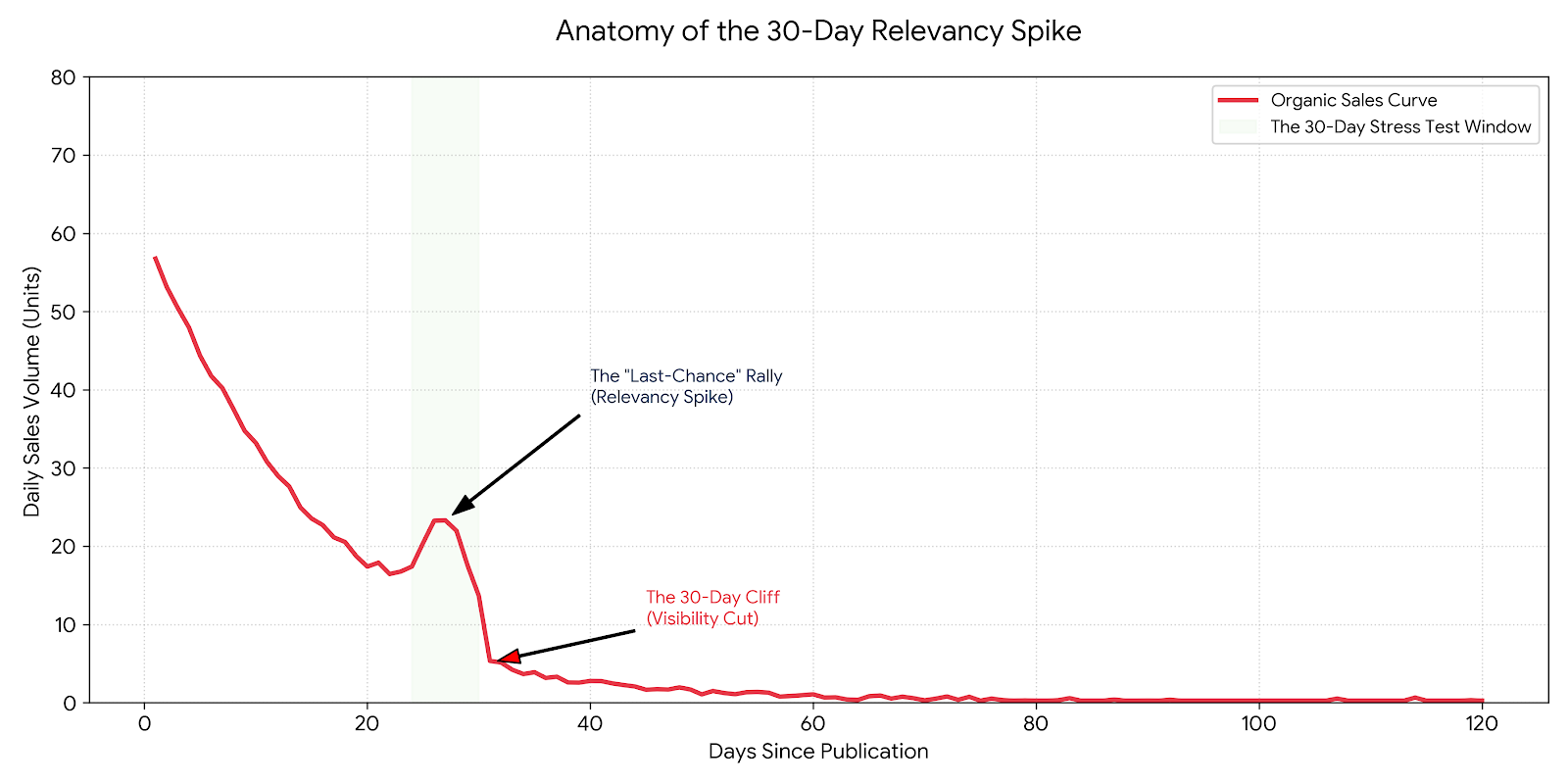
That is until day 28. During those first 28 days A10 has noticed that this e-book has (comparatively) sold well. So it thinks that maybe it is a a best-seller in disguise! Is it (maybe) in the wrong category? A10 gives it one last boost up the rating and also widens the areas over which it is advertised. As a result the book gets more sales!

But! How many more? If it soars A10 is happy. The rise will become self-fulfilling – more sales – more visibility – more visibility – more sales.

But if on Day 30 it just looks like it was in the right category after-all and it has in effect exhausted it’s audience then A10 removes all preferential treatment from the e-book. Now it must sink or swim by it’s own sales alone. This is the 30-Day Cliff Edge.

E-Book Life and Death. Here is is in more detail.

self publishing: Life and death of an e-book. 30-day relevancy spike after publication

Sales collapse. On day 29 (the peak of the spike) it sold 29 copies. On day 31 it sold 6. then it staggers down over a couple of months to the Grave of Zeros. It’s dead.

That remember, that was the life and death for a SUCCESSFUL “publish and pray” (aka no advertising) e-book.

If the e-book was positioned at £0.75 a copy ( with 35% royalty) it would have made about £275 in these 30 days. The next 30 days it would be about £20. From then on it’ll be (maybe) £1 a month (if you are lucky). Say £300 all in. That’s for a successful “Publish and Pray” e-book in the top 1.5% of sales.

Sure. If the e-book charged more per sale then not only would you potentially move out of the 35% royalty bracket into the 70% royalty bracket and you would get even more per sale. But lets be honest, how likely do you think a “publish and pray” e-book priced at (say) £4.99 is going to perform like the one above? It’s Fairyland.

But, lets go to Fairyland. Say you did sell 1051 e-books at £4.99. You would get £3.49 per e-book in royalties. That is a grand total of £3667 in 90 days. Say £4000 in total.

For what is an expensive e-book with no promotion that (somehow) reaches the dizzy heights of being in the top 1.5% of e-book sales. You make £4000.

How long did it take you to write this thing?

Let us say that the £0.75 e-book was more-or-less self published with little external input and only took you six weeks to write at 10 hours a week. (in almost cases that is really, really, wildly over-optimistic) then you will have been working for 300/60 = £5 per hour.

Lets say the £4.99 book takes 500 hours. ( aka ~4 months work) . We will ignore the fact that at that price people expect more. You will need a professionally produced cover and professional proof reading. They don’t come cheap. But never mind. Lets ignore that.

In this case then you will have been working for £4000/500 hours = £8 per hour.

Remember That Is the Life and Death For A Successful e-book.

For the £0.75 e-book, the chances of even achieving this return (in my humble opinion) are remote.

For the £4.99 e-book they are so remote they are in another universe.

In either case you would get considerably more stacking shelves in the supermarket.

The main take-out from this is that although a successful non promoted e-book will make money it will be a paltry return on the time, sweat and grief invested in writing it.

Anything less than success at this level (aka within the top 1.5% of e-book sales) will mean you have been working for nothing.

So I come back to my underlying theme that goes right through this series

WHY ARE YOU WRITING? Is it for love? Or money?

If it’s just to make money and you simply cast your e-book “out there” you are almost certainly onto a loser.

The only real way to have the possibility of making money from writing and self publishing entails continual writing, continual publishing, cross referencing between stories and never ending promotion. Some love it. Many regard it as a treadmill. More in the next post.

So it is a perhaps good thing that most people writing e-books do it for the love of writing and the thrill of publishing rather than the prospect of making a million. Though the dream of that possibility may still be there!

So do what you love! Writing and self publishing is like a love affair.

But like any love affair, if you are only in it for the money you will end up disappointed.

Next post deals with the promoted e-book launch aka the blue line above.

Self Publishing: A Look at the Odds of Financial Success

Despondent over low sales? Look at the reality. What really are the odds of financial success? Then ask yourself why you are writing. If its to be a Zillionaire you’re in for a hard time. But if it’s for the love of writing that may be different. The previous post in this series is here – Self Publishing: the Reality of the Numbers

A Table of Betting Odds of Financial Success

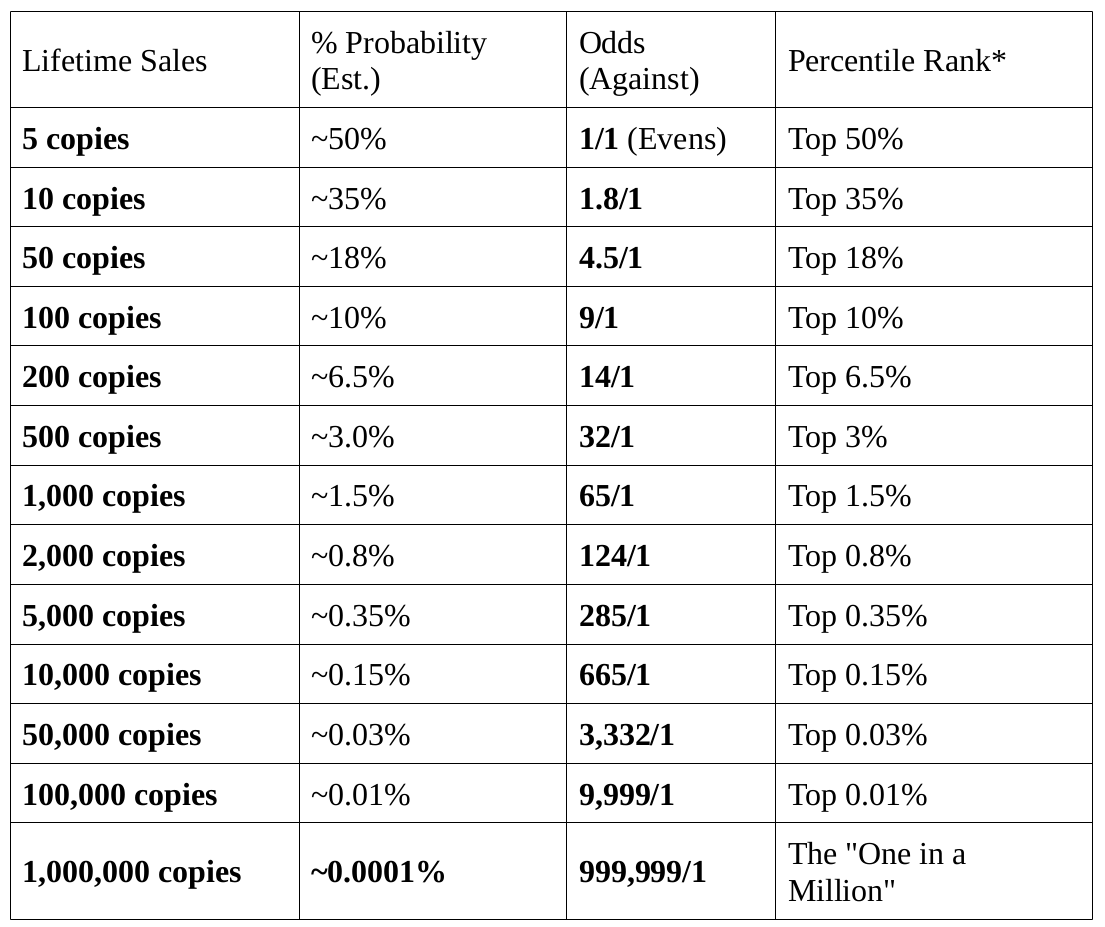
If you assumed all e-books as equal and you wanted to place a bet on the number of copies a particular e-book would sell in the first 90 days these the odds you would get.

self publishing: the odds of financial success

*The astute among us will realise the Percentile Rank column (which should add up to 100) actually adds up to 125. There is a reason for this. It tells us a great deal about the typical e-book promotion effort. More in a later post.

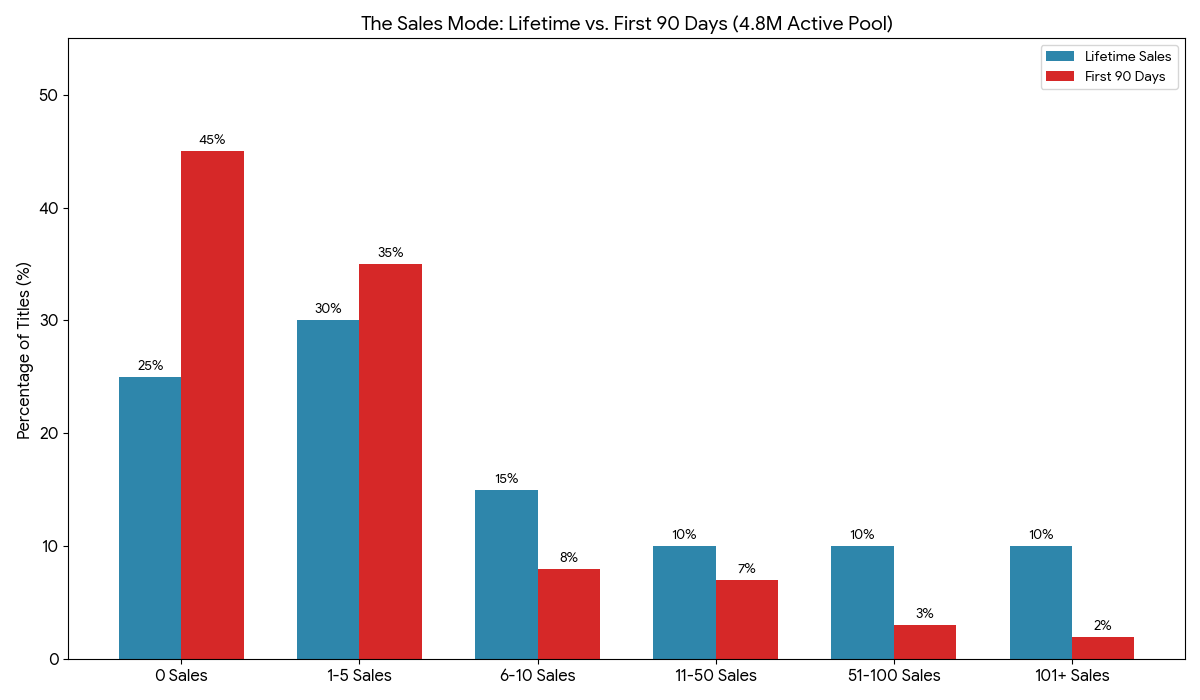
So from this you would guess that half of all e-book titles sell only 5 copies in the first 90 days. In fact it’s worse than that.

Self Publishing: the odds of financial success. Lifetime sales and 90 day sales.

Most fiction e-books on Amazon sell fewer than 100 copies in their lifetime, with over half of those failing to ever cross the 10-copy threshold.

There are 4.8 million active English fiction titles on Amazon. Of that number only about 150 titles at any given time are selling at a rate which might eventually see more than a million sales.

Odds of Financial Success? Success is “Sticky”

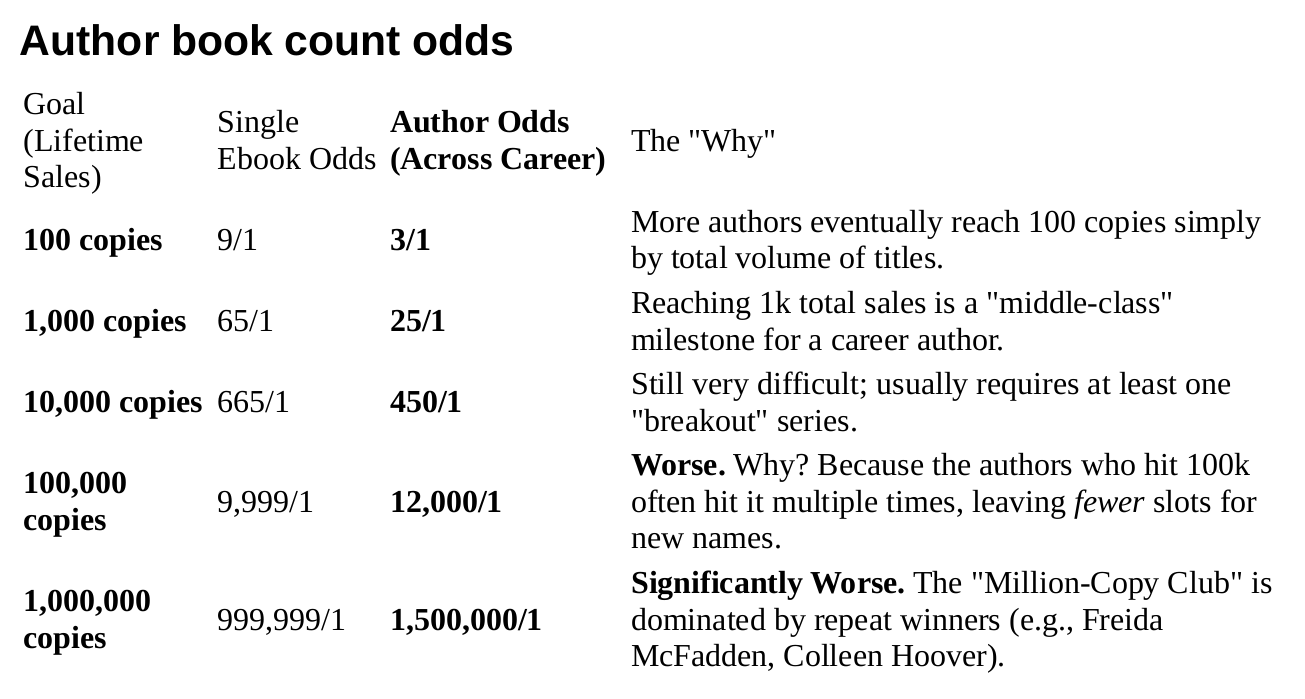
Authors (generally) do not write just one e-book. In fact most e-book authors on Amazon have written 5. When you come to financially successful writers (aka people making significant money) it is often more than 25. There are virtually no authors making serious money who have published just one or two e-books.

And success is “sticky”. A successful author is likely to have multiple successful e-books. Not just one or two. So that extends the odds further.

If you draw up a table of authors (rather than individual e-books) then odds of any random author reaching a particular level of sales is as follows.

Self Publishing: Successful authors book count and the odds of financial success

So Why Are the Odds so Steep and the Sales so Low?

These odds are so steep because the entry cost is zero. As I am sure you are aware, publishing on Amazon or B&N is not like traditional publishing. In traditional publishing there’s a “filter” (aka agents/editors). They remove 99% of proposed books before they hit the shelf. Amazon and B&N allow everything.

This ease of access creates a massive “denominator” of millions of books that have zero marketing budget. This pushes the odds of success for any randomly selected book into the thousands-to-one range.

The Future on KDP Amazon

The numbers are also growing. By 2030 the number of e-book titles is expected to go up by 70%. This will be heavily driven by AI created books. AI will remove a great deal of the plain old drudge associated with writing producing a book. Consequently it will become much easier to actually write produce one. The consequences of this is that even though reader engagement is likely to rise, the average number of sales per book will decrease even below the miserly numbers we see today. The median (i.e. the most common) sales volume will drop by about 60%.

Today (2026) Amazon has approximately 4.8 Million active fiction titles and 44 million assorted “works”. They are adding roughly 750,000 new fiction titles each year. This has accelerated and is still accelerating. Uploads to Amazon have tripled since 2022. While most of these will die a sudden death after the first 30 days (or less) I am sure you can see nothing is going to get easier.

So Why are you Writing? Love? Or Money?

Seriously. Why are you writing? Is it to become a Zillionaire? While it is nice to have that as a remote possibility, if that’s what’s driving you I’d suggest you are going to have hard time.

As time goes on the chances of success are not going to get any better. In fact if you limit yourself to Amazon even with a cunning game plan the chances are quite slim and probably getting worse by the day.

The market is crowded. Sales are hard to come by. It is unlikely you will breach 1000 copies on Amazon irrespective of how good your book is.

Unless that is, you indulge in extensive (and costly) marketing and cross e-book promotion by having a series of number of titles. Even then financial success is a very, very long way from being guaranteed. In fact you may end up losing money.

Add to that most authors I’ve met hate marketing (I loath it) and it often literally takes more time and effort than actually writing the damn thing.

But so what?

Do You Love Writing?

If so then 10 readers is success. As long as you have not got yourself locked into the delusion that you are bound to make it big and become a zillionaire then 10, 100 or 1000 is success and the more the merrier.

In which case, while Amazon is worthwhile (after all it’s free) other platforms may actually be more appropriate.

Be realistic. And remember – money isn’t everything.

The next post in this series is here Life and Death of a Fiction e-Book

Love and kisses

Chalkie xx

Self Publishing: The Reality of the Numbers

Lets get real about how many e-books you are likely to sell via Amazon KDP. Let’s check out the reality of the numbers. Part of a data heavy series on self-publishing. The previous post is Here.

The Numbers: Reality and Illusion

We see the terms like “Block Buster” or “Best Seller” or “Black Swan”. But what do they even mean? What really is the reality of the numbers?

Moreover:

  • What sales correspond to a best seller?

  • How common are best sellers?

  • What sales can the average author expect for say, not a best seller, but a “good seller”?

  • What sales level corresponds to failure and what is merely average?

  • What sales level can be declared a success?

  • And what sales level is the most common?

The Hard and Bitter Reality of the Numbers

Here’s come the answers.

Before reading this I’d suggest you sit down. Or at least stand well clear of breakable objects. Few people know how polarised sales are with the winner takes all in the ascendant.

The data here in effect compounds the depressing data we have already seen. But, as I said it does (eventually) gets better. This gets a bit techie. But don’t worry about that. The main takeaways are in bold.

The best way to describe overall e-book sales is to say they obey a power law. If we want to get technical then e-book sales can be said to look a lot like a Pareto or Zipf distribution.

For those who want to know, a true Parento distribution describes how a small percentage of the population owns most of the wealth. While Zipf’s law states that the frequency of an item occurrence is inverse to it’s rank. Like one million people receive just one dollar while one just person receives one million dollars.

In out particular case (e-book sales) this Power Law is driven by Preferential Attachment and the so-called “Matthew Effect”.

In essence this means that in e-book sales, visibility is tied to sales rank. So the more a book sells, the higher it ranks. The higher it ranks, the more it is shown to new buyers. The more it is shown to new buyers the more it sells. The more it sells, the higher it ranks… And so on.

This means that any small initial advantage in sales/placement/visibility compounds over time and leads to disproportionality greater success. Meanwhile those without that advantage fall ever further behind. Their rate of descent into the abyss compounds too. They enter an ever tightening spiral down to oblivion.

The statement “The Rich Get Richer” and the “Poor get Poorer” encapsulates it perfectly. (But on steroids).

The Graphical Reality of the Numbers

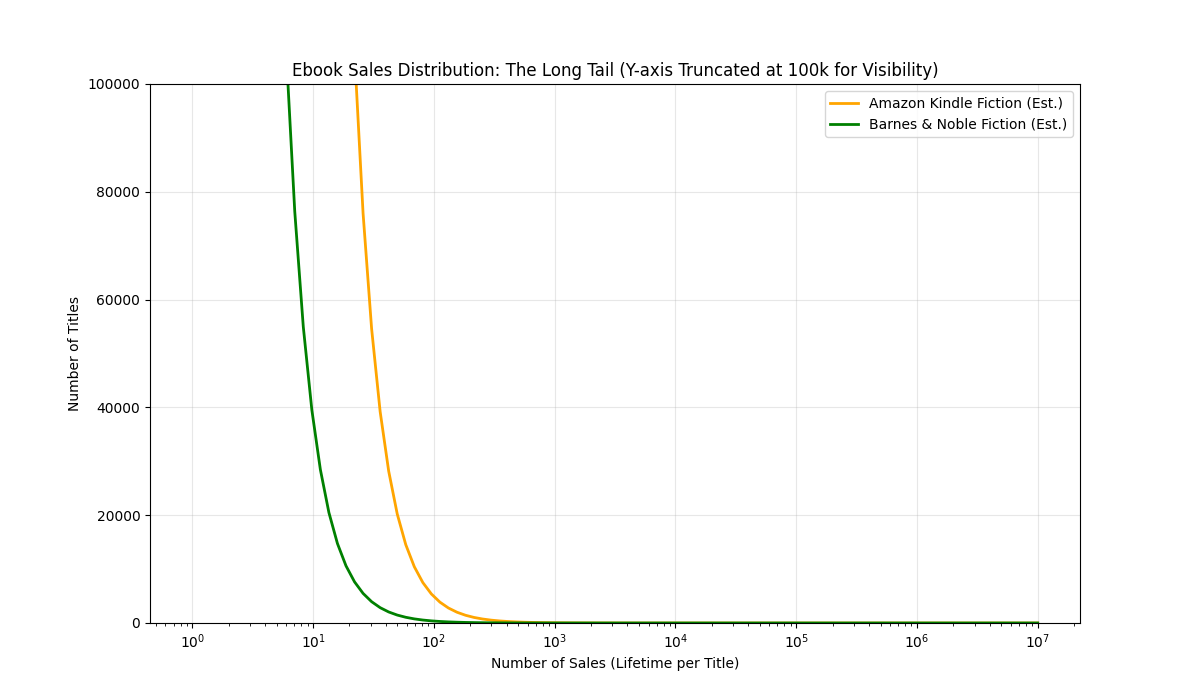
The result of this is that if we draw a graph of sales quantity (x-axis) against number of titles we get a meaningless and almost vertical line. To make it actually legible we need to cap the number of titles to the most popular 100,000 and then make the number of sales a logarithmic scale i.e. steps are 10, 100, 1000, 10,000, 100,000, 100,000,000 etc. Here is what we get for Amazon and Barnes & Noble. Notice how similar the curves are. So it looks like Barnes & Noble follow similar sales practices to Amazon. No surprise there!

The Reality of the Numbers: e-book Sales Distribution. The Long Tail

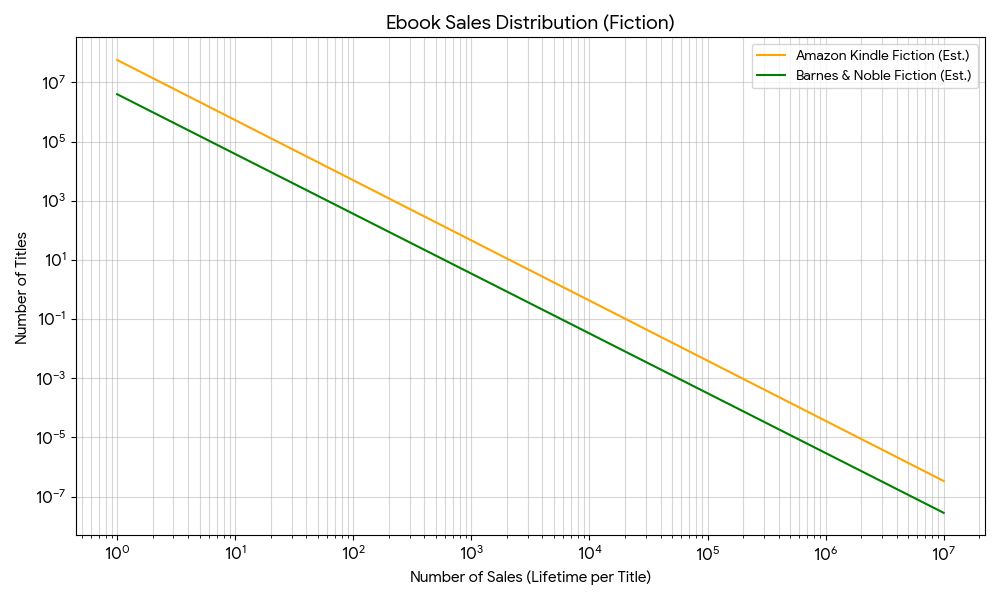
You can better represent the above data by a log-log graph where each axis is a log scale not just the x-axis. If you do that you get a graph like this. From this we can see that very, very, few e-book titles sell more than 1000 copies. (The y-axis is per-cent)

The reality of the numbers: e-book sales distribution for fiction titles.

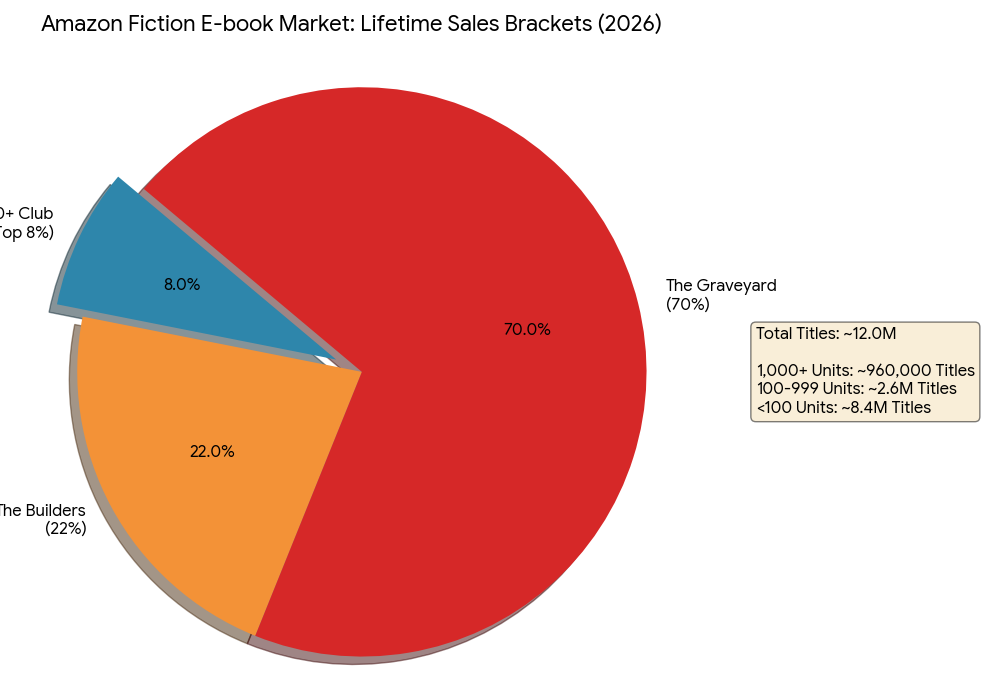
So on close inspection you’ll see that about 8% of e-books make it eventually to 1000 sales. So just under 1 million e-books on Amazon will make it (eventually) 1000 sales. (that’s with 12 million e-books in the Active Fiction E-book Catalog)

Here’s it in a pie chart

The reality of the numbers: Amazon Fiction e-book market lifetime sale pie chart

The Real Reality of the Numbers.

So (to me at least) I’d suggest that anything over 400 – 500 sales is something to be really proud of. While anything approaching 1000 sales should be labelled SUCCESS.

Often authors get despondent when their e-books don’t sell. But as you can see it is nothing unusual. Nobody should start labelling their work as a failure. Even if it sells under 10 copies.

The reality of the numbers screams at you that the dice are loaded. But – if you don’t play, you can’t win!

The next post is A Look at the Odds of Financial Success

Love & Kisses

Chalkie

Self Publishing: The Grave of Zeros

Your new e-book isn’t selling and you don’t know why. You’re not alone. You need to know the scale of the problem before tackling a way ahead. Part of a data heavy series on self-publishing.

In my first post in this series I highlighted the main problem authors face is not writing/editing but getting their work seen and read. So in this post I intend going through the basic numbers surrounding on-line fiction e-book sales.

We will start with some shocking statistics. There will be many more to follow in following posts. But if you are going to devote hours and hours of your life to writing then you need to know where you stand. You cannot address a problem like this unless you understand it. That’s the whole reason I first looked at this data myself.

A Look into the Grave of Zeros

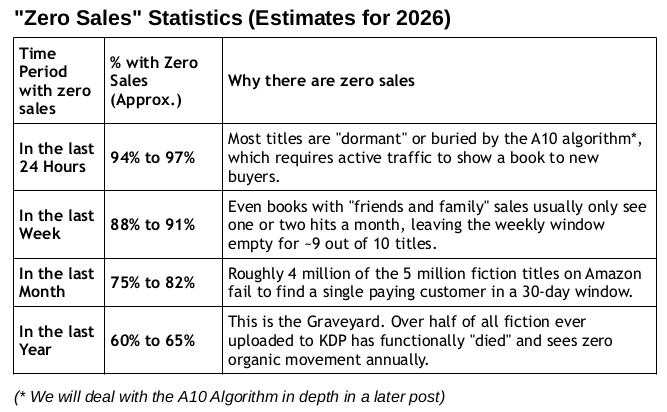
This set of estimates is for is for Amazon KDP. You you can be pretty sure it will be much the same for Barnes&Noble (Nook) as well.

Garve of Zeros. Zero Sales Statistics for 2026

Depressing isn’t it?

But it gets worse. (Don’t worry – it DOES get better later! But not today.).

I must emphasise we need to deal with this bad news up-front so we know where we stand. We cannot hope to address a problem like this and attempt to find a fix or work-round until we know what we are dealing with.

Almost all authors simply do not have a clue about the statistics surrounding on-line fiction sales. That is one of the reasons a huge number of them won’t ever stand a chance of selling even twenty copies. Let alone make a reasonable return on their investment of time, energy and sweat.

Next post we will get into the real meat and potatoes of the statistics surrounding on-line fiction e-book sales.

Love & Kisses

Chalkie