How long does an e-book typically sell for? Here we look at the very brief life and death of a fiction e-book. A two part post looking at non promoted and promoted e-book launches and the duration of sales. The previous post in this series – A Look at the Odds of Financial Success
So far in this series I been looking at the issues surrounding e-book sales macroscopically or globally. i.e. the issues that affect the whole 4.8 million active fiction e-books on Amazon for example.
What I’m going to do now is look at how this all relates to individual e-books and especially how they sell and are presented by the Amazon A10 sales algorithm within that crucial first 90 days.
Over this and the next post I’ll look at the typical performance of two newly released e-books. Lets assume that the release for both “goes well”. i.e. they both actually achieve sales(!) and as far as their peers and the rest of the pack are concerned, they are “successes”.
Here is how their sales go. The red line is for an non promoted e-book (aka publish and pray) and the blue line is for an typical e-book that has advertising money invested in it’s promotion and some kick-back from linked books (aka a series).
I’ll look at the red line in this post and the blue line in the next.
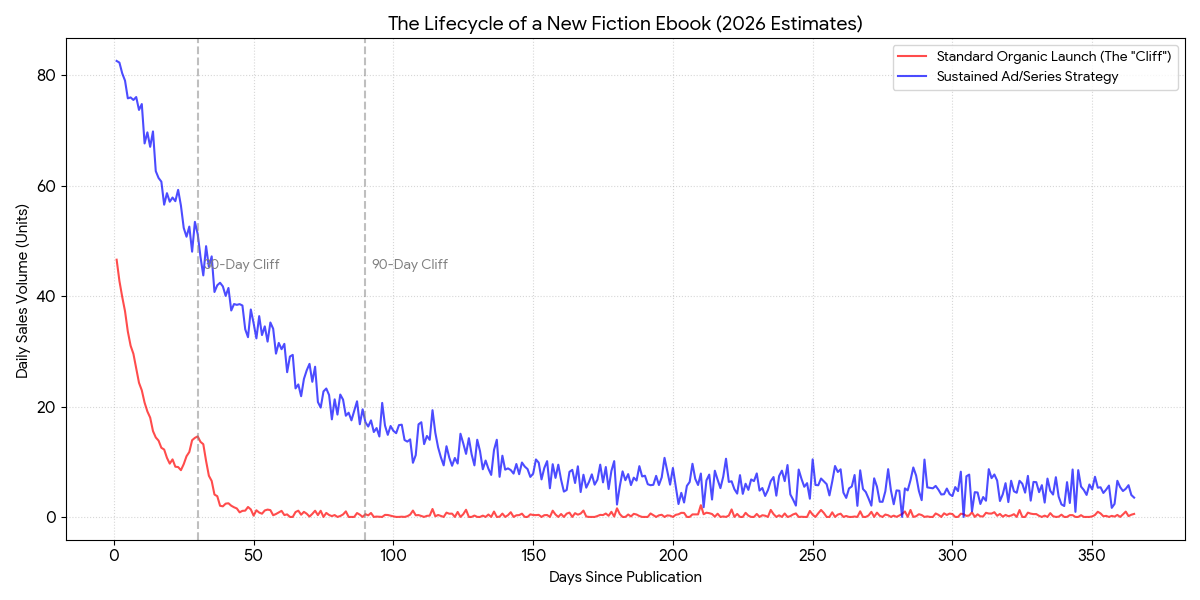
I must emphasize both of these two e-books are “successful”. The “Standard Organic Launch” (red line) sells 1051 e-books in its first 90 days. That puts it in the top 1.5% of all e-book sales. The “Sustained advertising with kick backs from series” e-book (blue line) sells 3425 e-books in the first 90 days. Which puts it in the top 0.5% of all e-books.
The big take-out from this is that for the non advertised “publish and pray” e-book, even for a successful one, it will be effectively dead within about 35 days.
But this is a SUCCESSFUL e-book! Almost all “publish and pray” e-books are dead on arrival. i.e. there is no downward curve. It flatlines at zero from day one. They (maybe) sell five to ten copies. Mostly to family and friends.
Sure there are exceptions. Just in the same way people win millions on the lottery or get hit by lightning. But it is so rare you can safely assume it will never happen to you (or your e-book)
Let us deal with the shape of red line first. As I said I’ll look at the blue line in the next post.
Life and Death of a Fiction e-Book: Red Line (Publish & Pray) Analysis
On publication, the Amazon A10 algorithm gives new e-books an advantage. This preferential treatment lasts for the first 30 days. They appear artificially higher in standard customer search and get extra promotion from things likes “Hot New Titles” etc. But this position is maintained (or lost) solely by the e-book’s sales activities within this month.
I’ll make some assumptions here. I would suggest that in the case of this red line the author has got all his family and friends on board. They each buy the e-book and write dazzling reviews.
What the A10 Algorithm Looks At
The Amazon A10 algorithm notices the sales (and especially the reviews) and pushes the e-book up the list. It gets more views and makes some real sales. But it is not just sales and reviews. The A10 algorithm looks at a raft of other criteria.
- How many people read the description?
- How far do they read through the sample?
- Was the access to the sales page via an external link?
- How long they stay on the e-books sales page?
All these aspects of the e-books presence (and more) contribute to it’s position in the listings.
The e-book has to satisfy enough of these criteria to convince the A10 algorithm that it is worth keeping it at the inflated position it has in the listings. But if it flags A10 pushes it down the listings. That is because A10 continuously monitors for both success and failure. As it falls down the list it sells less and becomes less visible. The less it sells the further down it goes.
Life and Death of an e-Book – With a Dead Cat Bounce
That is until day 28. During those first 28 days A10 has noticed that this e-book has (comparatively) sold well. So it thinks that maybe it is a a best-seller in disguise! Is it (maybe) in the wrong category? A10 gives it one last boost up the rating and also widens the areas over which it is advertised. As a result the book gets more sales!
But! How many more? If it soars A10 is happy. The rise will become self-fulfilling – more sales – more visibility – more visibility – more sales.
But if on Day 30 it just looks like it was in the right category after-all and it has in effect exhausted it’s audience then A10 removes all preferential treatment from the e-book. Now it must sink or swim by it’s own sales alone. This is the 30-Day Cliff Edge.
E-Book Life and Death. Here is is in more detail.
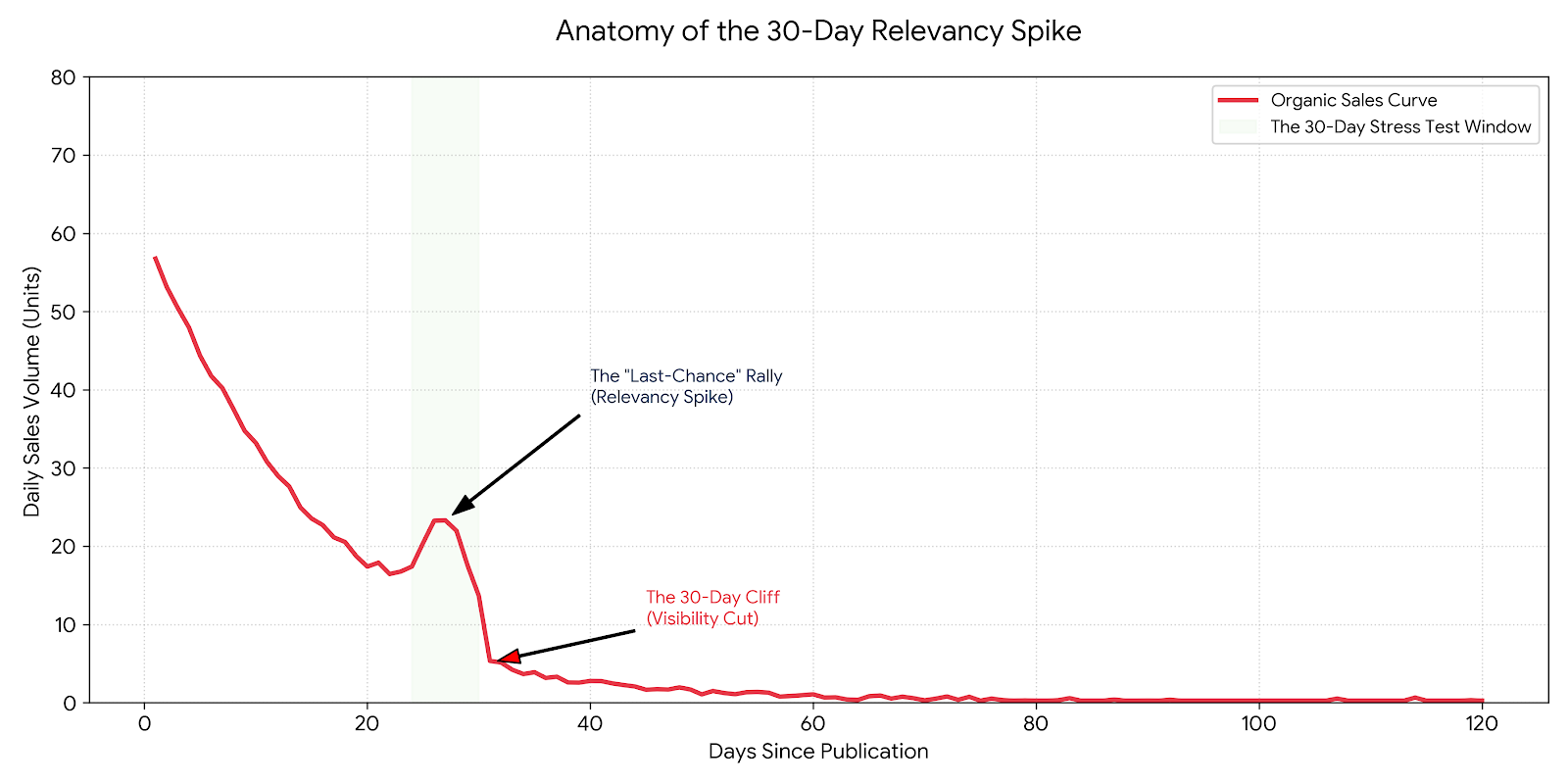
Sales collapse. On day 29 (the peak of the spike) it sold 29 copies. On day 31 it sold 6. then it staggers down over a couple of months to the Grave of Zeros. It’s dead.
That remember, that was the life and death for a SUCCESSFUL “publish and pray” (aka no advertising) e-book.
If the e-book was positioned at £0.75 a copy ( with 35% royalty) it would have made about £275 in these 30 days. The next 30 days it would be about £20. From then on it’ll be (maybe) £1 a month (if you are lucky). Say £300 all in. That’s for a successful “Publish and Pray” e-book in the top 1.5% of sales.
Sure. If the e-book charged more per sale then not only would you potentially move out of the 35% royalty bracket into the 70% royalty bracket and you would get even more per sale. But lets be honest, how likely do you think a “publish and pray” e-book priced at (say) £4.99 is going to perform like the one above? It’s Fairyland.
But, lets go to Fairyland. Say you did sell 1051 e-books at £4.99. You would get £3.49 per e-book in royalties. That is a grand total of £3667 in 90 days. Say £4000 in total.
For what is an expensive e-book with no promotion that (somehow) reaches the dizzy heights of being in the top 1.5% of e-book sales. You make £4000.
How long did it take you to write this thing?
Let us say that the £0.75 e-book was more-or-less self published with little external input and only took you six weeks to write at 10 hours a week. (in almost cases that is really, really, wildly over-optimistic) then you will have been working for 300/60 = £5 per hour.
Lets say the £4.99 book takes 500 hours. ( aka ~4 months work) . We will ignore the fact that at that price people expect more. You will need a professionally produced cover and professional proof reading. They don’t come cheap. But never mind. Lets ignore that.
In this case then you will have been working for £4000/500 hours = £8 per hour.
Remember That Is the Life and Death For A Successful e-book.
For the £0.75 e-book, the chances of even achieving this return (in my humble opinion) are remote.
For the £4.99 e-book they are so remote they are in another universe.
In either case you would get considerably more stacking shelves in the supermarket.
The main take-out from this is that although a successful non promoted e-book will make money it will be a paltry return on the time, sweat and grief invested in writing it.
Anything less than success at this level (aka within the top 1.5% of e-book sales) will mean you have been working for nothing.
So I come back to my underlying theme that goes right through this series
WHY ARE YOU WRITING? Is it for love? Or money?
If it’s just to make money and you simply cast your e-book “out there” you are almost certainly onto a loser.
The only real way to have the possibility of making money from writing and self publishing entails continual writing, continual publishing, cross referencing between stories and never ending promotion. Some love it. Many regard it as a treadmill. More in the next post.
So it is a perhaps good thing that most people writing e-books do it for the love of writing and the thrill of publishing rather than the prospect of making a million. Though the dream of that possibility may still be there!
So do what you love! Writing and self publishing is like a love affair.
But like any love affair, if you are only in it for the money you will end up disappointed.
Next post deals with the promoted e-book launch aka the blue line above.