Lets get real about how many e-books you are likely to sell via Amazon KDP. Let’s check out the reality of the numbers. Part of a data heavy series on self-publishing. The previous post is Here.
The Numbers: Reality and Illusion
We see the terms like “Block Buster” or “Best Seller” or “Black Swan”. But what do they even mean? What really is the reality of the numbers?
Moreover:
-
What sales correspond to a best seller?
-
How common are best sellers?
-
What sales can the average author expect for say, not a best seller, but a “good seller”?
-
What sales level corresponds to failure and what is merely average?
-
What sales level can be declared a success?
-
And what sales level is the most common?
The Hard and Bitter Reality of the Numbers
Here’s come the answers.
Before reading this I’d suggest you sit down. Or at least stand well clear of breakable objects. Few people know how polarised sales are with the winner takes all in the ascendant.
The data here in effect compounds the depressing data we have already seen. But, as I said it does (eventually) gets better. This gets a bit techie. But don’t worry about that. The main takeaways are in bold.
The best way to describe overall e-book sales is to say they obey a power law. If we want to get technical then e-book sales can be said to look a lot like a Pareto or Zipf distribution.
For those who want to know, a true Parento distribution describes how a small percentage of the population owns most of the wealth. While Zipf’s law states that the frequency of an item occurrence is inverse to it’s rank. Like one million people receive just one dollar while one just person receives one million dollars.
In out particular case (e-book sales) this Power Law is driven by Preferential Attachment and the so-called “Matthew Effect”.
In essence this means that in e-book sales, visibility is tied to sales rank. So the more a book sells, the higher it ranks. The higher it ranks, the more it is shown to new buyers. The more it is shown to new buyers the more it sells. The more it sells, the higher it ranks… And so on.
This means that any small initial advantage in sales/placement/visibility compounds over time and leads to disproportionality greater success. Meanwhile those without that advantage fall ever further behind. Their rate of descent into the abyss compounds too. They enter an ever tightening spiral down to oblivion.
The statement “The Rich Get Richer” and the “Poor get Poorer” encapsulates it perfectly. (But on steroids).
The Graphical Reality of the Numbers
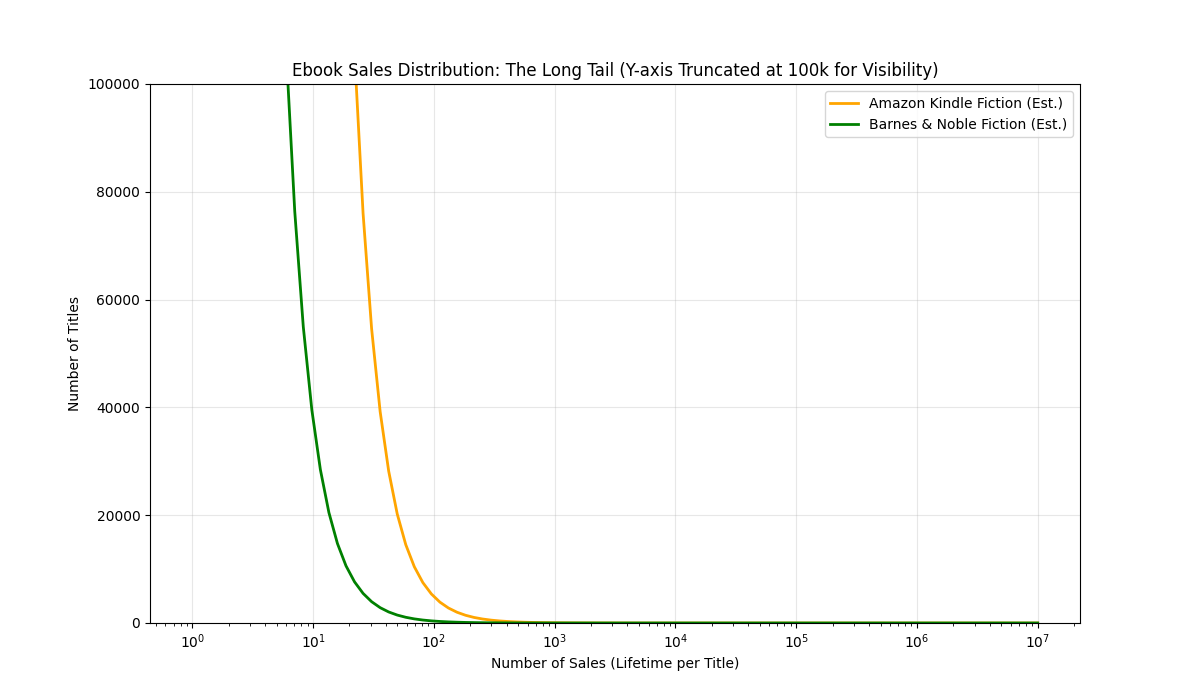
The result of this is that if we draw a graph of sales quantity (x-axis) against number of titles we get a meaningless and almost vertical line. To make it actually legible we need to cap the number of titles to the most popular 100,000 and then make the number of sales a logarithmic scale i.e. steps are 10, 100, 1000, 10,000, 100,000, 100,000,000 etc. Here is what we get for Amazon and Barnes & Noble. Notice how similar the curves are. So it looks like Barnes & Noble follow similar sales practices to Amazon. No surprise there!
You can better represent the above data by a log-log graph where each axis is a log scale not just the x-axis. If you do that you get a graph like this. From this we can see that very, very, few e-book titles sell more than 1000 copies. (The y-axis is per-cent)
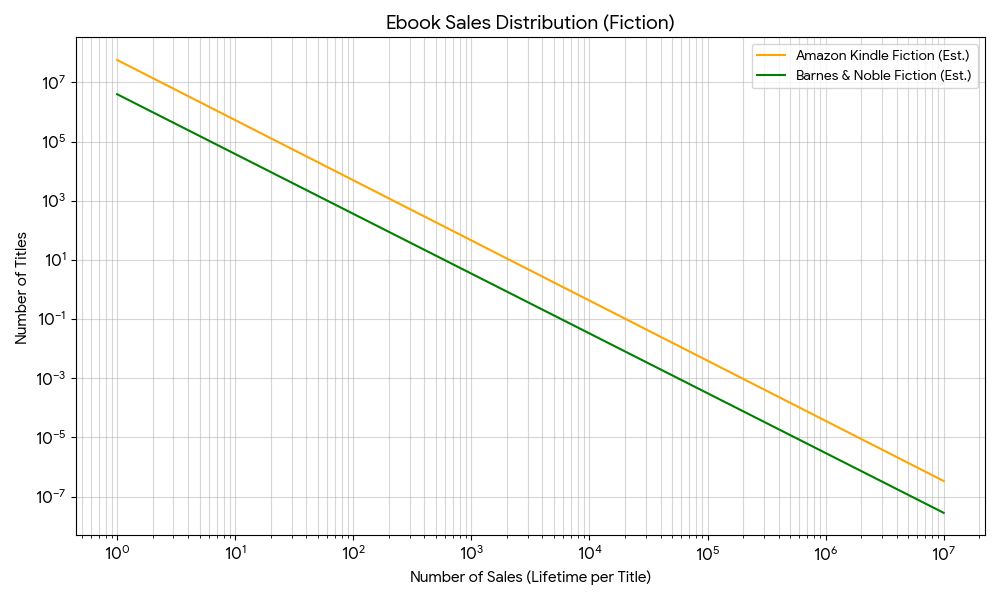
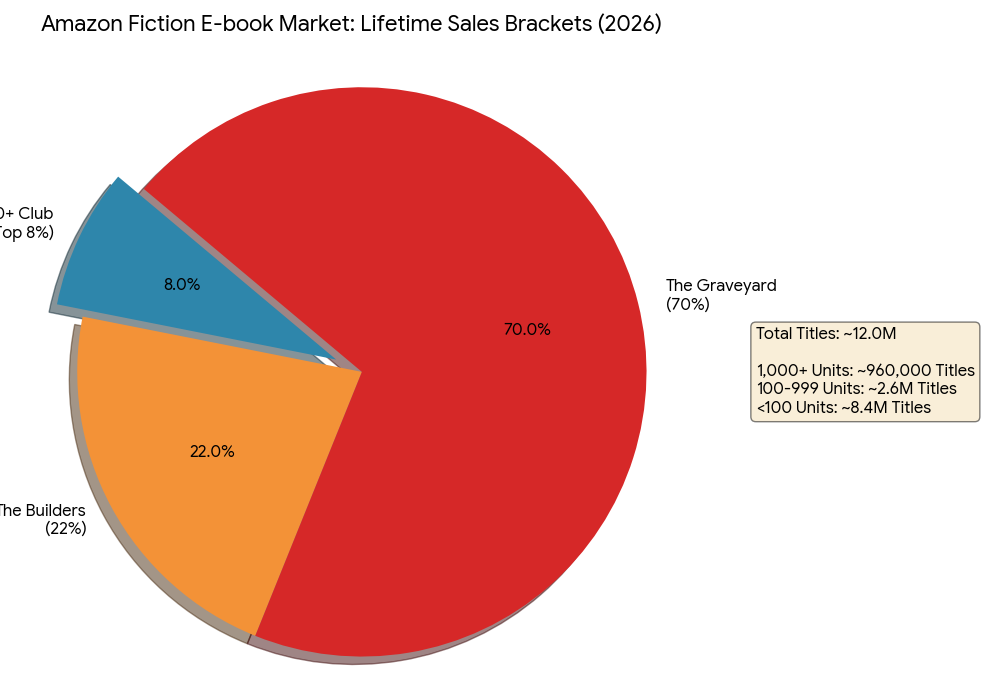
So on close inspection you’ll see that about 8% of e-books make it eventually to 1000 sales. So just under 1 million e-books on Amazon will make it (eventually) 1000 sales. (that’s with 12 million e-books in the Active Fiction E-book Catalog)
Here’s it in a pie chart
The Real Reality of the Numbers.
So (to me at least) I’d suggest that anything over 400 – 500 sales is something to be really proud of. While anything approaching 1000 sales should be labelled SUCCESS.
Often authors get despondent when their e-books don’t sell. But as you can see it is nothing unusual. Nobody should start labelling their work as a failure. Even if it sells under 10 copies.
The reality of the numbers screams at you that the dice are loaded. But – if you don’t play, you can’t win!
The next post is A Look at the Odds of Financial Success
Love & Kisses
Chalkie