A quick look at a common financial strategy for launching an e-book series. Here is a link to the previous post in this series “Why (and How) an e-Book series sells”
The new buzz word metric used to figure out the eventual profitability of an e-book series is a thing call “Lifetime Value” often abbreviated to LTV. LTV is really the average amount you make from a reader of your series and not just one particular book within it. What this metric is in essence a way of figuring out how much you can overspend (aka lose) on e-book One and still make an overall profit on the series.
Evidently this is the method used by numerous high-earning authors in 2026. (Or so I am told.)
The “Loss Leader” Setup
The most common pricing structure in 2026 for a newly released series (in this case of three e-books) is as follows:
-
Book 1: $0.99 (The “Hook”) — Royalty: $0.35
-
Book 2: $4.99 (The “Bridge”) — Royalty: $3.50
-
Book 3: $4.99 (The “Climax”) — Royalty: $3.50
The e-Book Series “Sell-Through” Maths
Based on 2026 benchmarks they (that’s the high earning authors) typically look for a 50% Read-Through from Book 1 to 2, and a 75% Read-Through from Book 2 to 3.
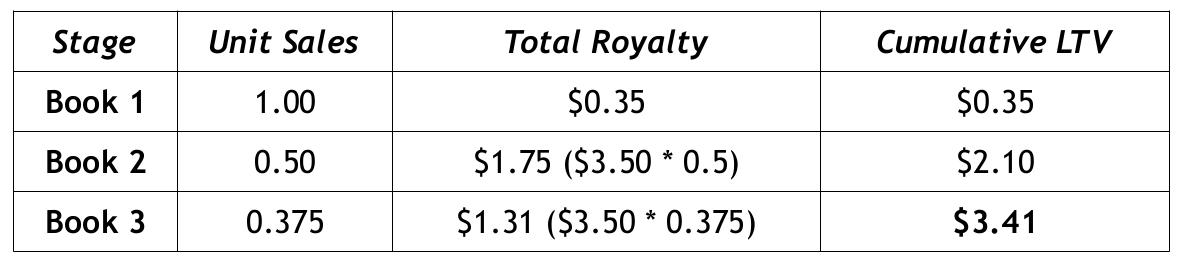
So the end result from the above table is that the LTV (Average Revenue Per Reader) is $3.41.
Even though the first be-book is at a bargain basement price and makes only 35 cents, every person (on average) who buys the cheap e-book is worth $3.41 to you in the long run.
The e-Book Series “Break-Even” Advertising Limit
OK. Now that we know the average reader (for our relatively successful e-book series) is worth $3.41. But we have not paid for the advertising yet to get those readers.
We can though now calculate how much we can spend on Amazon/Facebook ads to find them. Of course if they don’t respond to the adverts, we have a problem. But for the moment let us imagine all goes well.
In 2026, a standard conversion rate for a well-targeted advert is one sale for every ten clicks. i.e. a 10% conversion rate. So nine duds for every hit. If it’s better, we are in clover. If it’s worse, we are in trouble.
But lets assume we make the 10% conversion rate. We can now figure out how much each click is worth on average. So if we take our LTV and spread it over the number of clicks that are necessary to actually make the LTV.
We get $3.41 ÷ 10 Clicks = $0.34 per click.
So, if (and only if) you can keep your “Cost Per Click” (CPC) below $0.34, this 3-book series will be (eventually) profitable. But it also means that you (typically) make nothing on e-book One. You may well actually lose on it. At least for part of the time. But without the cheap, zero-profit cum loss-leader e-book One – nothing works.
Minimum e-book series length
I hope you can also see that a three book series is really the minimum series length. The financials for a two e-book series is much more fraught. The reality is the longer that series is then the more likely it will financially succeed.
Going to the other extreme, if you decided to release e-book One as a stand-alone at 99 cents, your adverts would have to be 3 cents or less per click-through to make money. If you compensated by making the e-book more expensive then you are unlikely to get anywhere near a sale for every ten clicks.
The brutal reality is stand-alone authors almost always lose money on ads. (more in next post) While series authors almost always lose money on the first e-book in the series.
At the risk of beating this to death I intend (in the next post) to actually look at what I’ve found out about advertising a stand-alone with figures and a realistic scenario.
It’s not pretty. Here’s the link to “Launching a Stand-Alone e-Book with Advertising”
Love & Kisses
Chalkie