How will a typical stand-alone (aka no series or theme) fiction e-book fare? How good are stand-alone e-book sales – with a significant advertising budget? It’s not pretty….
In my last post (Here) I indicated that using paid advertising (“publish and pay”) to promote stand-alone e-book sales was arguably even less financially successful than just doing an Organic (“publish and pray”) stand-alone e-book launch.
So why (you may say) doesn’t paid advertising work well for a stand-alone e-book?
Stand-alone e-Book Sales: Organic versus Advertised
Let us compare Stand-alone (no advertising – aka Publish and Pray) against Stand-alone but with a significant advertising budget. In this graph the data is at a lower x-axis resolution and more idealised compared to the one we showed in This Post and the 2 -3 day “hump” that appears around day 28 for a “publish and pray” e-book is hidden. We don’t have to worry about the hump for the paid advertising e-book anyway. Because it doesn’t get one! (more in a minute)
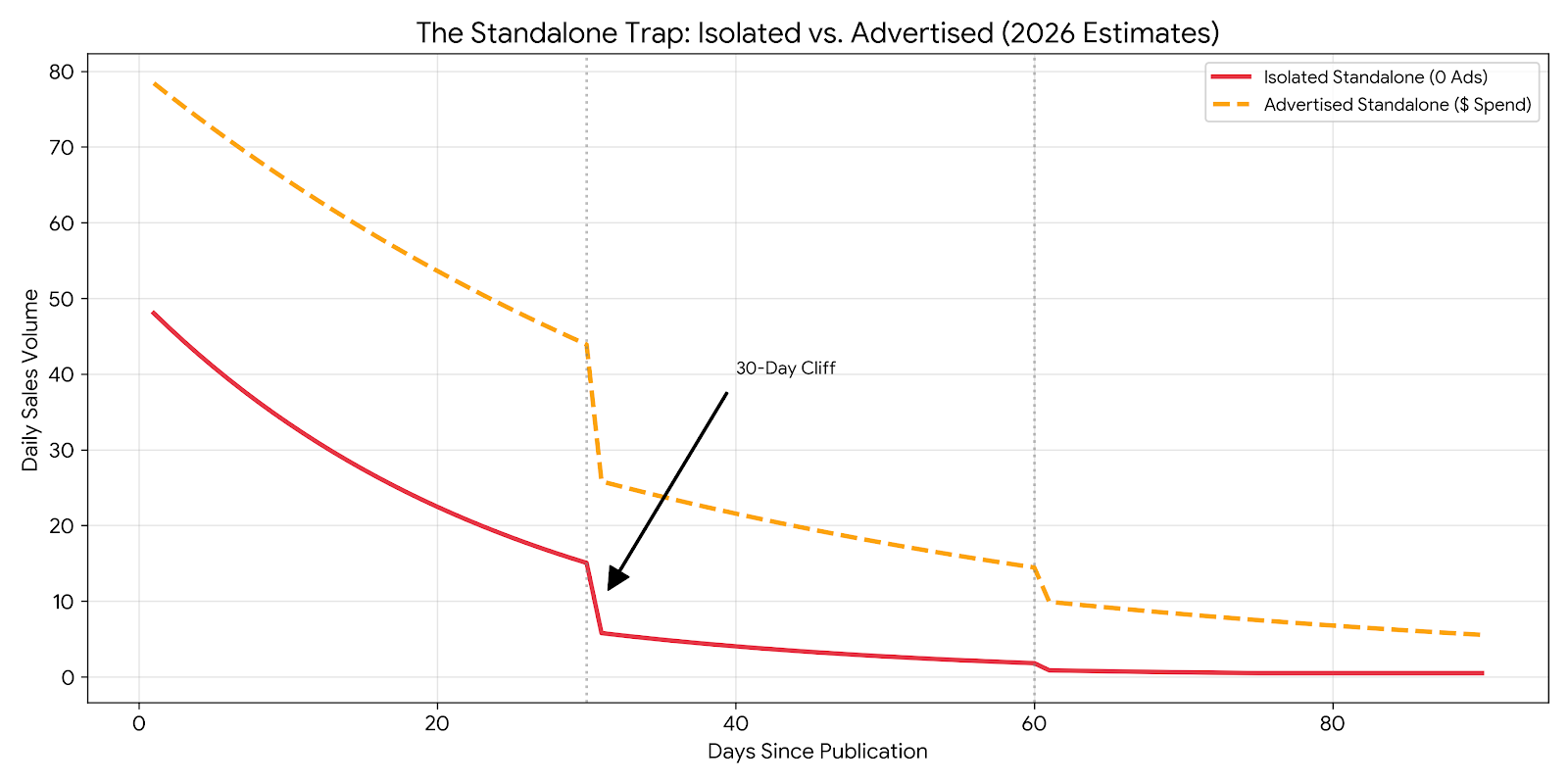
Notice how the advertised e-book mirrors the performance of the unadvertised e-book but just at a somewhat higher level of sales. This would be exactly the same if the yellow line was for the first book published in a series. The difference there though is that at day 90 book 2 of the series comes to the rescue.
Here’s the depressing bit. How much do you have to spend to get this far this advertised stand-alone e-book?
Advertised stand-alone e-book Sales Financial Commitment
To achieve that Orange Line in 2026, the author must commit to a “Brute Force” marketing strategy. Because there is no Book 2, 3 or 4 to come to the rescue, every single sale must be “bought.”
This will make your eyes water.
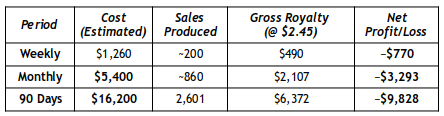
Advertised stand-alone e-book Sales Frequency of Costs:
You have to advertise daily. In 2026, the Amazon A10 algorithm penalizes “start-stop” advertising. To keep the orange curve from collapsing into the red curve, the spend must be continuous.
I am told that most stand-alone authors “tailor down” their spend around Day 45 when they realize they have lost nearly $5,000. The moment they do, the orange line drops vertically to meet the red line.
Here’s an idea of what gets spent to maintain a sales level in 2026 for a particular e-book. Don’t forget – this is for a successful e-book. There absolutely no guarantee that if you burn your savings on promoting this stand-alone e-book you will get even these Average Cost per Sale figures.
Average means just that. Some will be better and some will be worse.
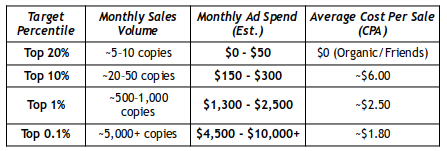
Why do the Top 1% pay less per sale?
You’ll notice that the “Cost per Sale” actually decreases as you move into the top tiers. This is due to the A-10 algorithm essentially giving a subsidy to it’s high performers.When an author spends $5,000 a month on Amazon Ads, the algorithm sees the high sales and begins showing the book in “Customers also bought” and “Recommended for you” sections for free.
If you have published (say) 10 e-books and they can be regarded, if not as a series, at least as e-books with a common theme (like crime, romance etc) then the system can work a bit like the series system works. Somebody buys a book, likes the authors style and buys another.
So an author can risk running a e-book promotion at a loss per sale in the knowledge (or hope) the reader will purchase more without the need for more loss-making advert click-throughs. So the author spends $2.50 to acquire a reader for Book 1, but that reader then buys Books 2 through 10 for free. This makes their actual marketing cost per sale across their entire catalogue much less.
Statistically, an author’s marketing spend only stands the chance of becoming “profitable” once they have at least 5 fiction titles in some form of connected theme or series.
What a Stand-alone Advertising Spend can Look like
But what if you ignore that and still go on a Hell for Leather advertising spend to get your e-book “out there”? Here’s what it is probably going to look like
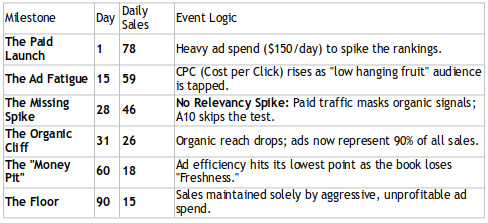
Stand-Alone e-book Author? The A-10 Algorithm is NOT your Friend
You have a stand-alone e-book that with one click will sell a maximum of one e-book. Almost always the cost of clicks that lead to that one successful e-book sale will be more than the royalty from that sale. You are literally “buying” customers for more than they are paying you.
The A10 algorithm sees a stand-alone book (even one getting lots of paid traffic) as a product that gets zero follow-through (no series or theme read-through leading to more sales). It concludes the book is not building revenue which is why, even with ads, you still hit the 30-Day and 60-Day cliffs.
Every pound/dollar you spend on advertising a stand-alone e-book is “burnt” the moment the advert is done. Even if it makes a sale. Every pound/dollar spent on an e-book in a series or theme that makes a sale has the potential to benefit future books in that series and also potentially earlier books too. And for free.
The hard basic truth is that a series author does not have to pay to promote every e-book because the promoted e-books does it for them. They only have to promote a sub-set of their inventory. Not only that but the Amazon A -10 algorithm also gives the series author a hand.
That is because A-10 is not really just a website search engine. Let alone an engine designed to promote new authors and literary fiction.
A-10 is not a mere Search Engine!
A-10 is a profit optimiser. That’s profit for Amazon by the way. Not you!
A-10 watches how a particular sale goes. Does the buyer click through to the authors Bio? If so do they then click through to other books by that’s author? If they subsequently buy other books because of their first purchase then the book they first bought is an asset. It brings in more money for Amazon. Remember A-10 is optimising sales for Amazon. The fact that you get a cut is irrelevant.
If an e-book brings in more money it gets more prominence. It gets “free” advertising from A-10 in “Recommended for You” and “Also Bought” adverts. It is displayed more prominently.
The e-book is seen as a magnet for Amazon. Not just of itself but crucially for other items. It is a champion for Amazon sales. Consequently A-10 ensures it prospers.
But if the book has no way of promoting and selling other items (beyond the initial sale of the e-book itself) then the e-book is an also-ran. It is not a champion money-maker for Amazon. It becomes inventory. A mere stock item that other than it’s own price, does not bring in money to Amazon.
Advertising Space is at a premium
Even on an enormous site like Amazon, advertising space is tight and precious. Meanwhile e-books are plentiful. Amazon is going to prioritise those items it believes will bring in the most money – to Amazon. So a series or sequence of e-books that feed off each other, with the sale of one leading to multiple other sales, will get rapidly pushed up the listings. While those that do not act like a champion are simply “Stock”. They rapidly fall into the Grave of Zero’s.
The Summary (aka The Important Bit)
The big take-out from this is if you want the chance of financial success on Amazon then in almost all circumstances it is CRUCIAL for a fiction e-book to be part of a series. If it is a stand-alone with advertising or no advertising, financially it is a loser.
That is of course if you are in this for the money.
But what if you are somebody who has written a single stand-alone e-book? Or writes unrelated fiction? i.e. multiple stand-alone e-books maybe using a number of pseudonyms. What then?
Well, to me at least, (statistically) it looks like (in fact I know) publishing a stand-alone work on Amazon KDP is not going to be a very effective way of getting your work out there. Let alone as a way of making money.
Sure, it may be well worth publishing on Amazon on the off chance you buck the stats and also so you can see your e-book as “complete”.
But you really should not start regarding yourself as a success/failure if your Amazon stand-alone e-book sells poorly. Comfort yourself with the knowledge that J.D Salinger (3 books), Emily Bronte (1 book) and Ralph Ellison (1 book) would have fared no better themselves today.
If you want the chance (and it is only a chance) of success on Amazon then you need to change the way you write to accommodate the A-10 algorithm by writing a series. You also have to live with the reality that this year another 750,000 e-books will be published on Amazon KDP.
So, ask yourself, do you want to do that?
Why are you writing?
If it is solely for the money then frankly in almost all cases your would be better off getting a part time job in a super-market stacking shelves. If it is not just for the money then you need to explore other avenues. I’ll try and elucidate on what I think these avenues are in future posts.
In those posts I’ll offer suggestions. But I will offer no advice!
Love & Kisses
Chalkie.